
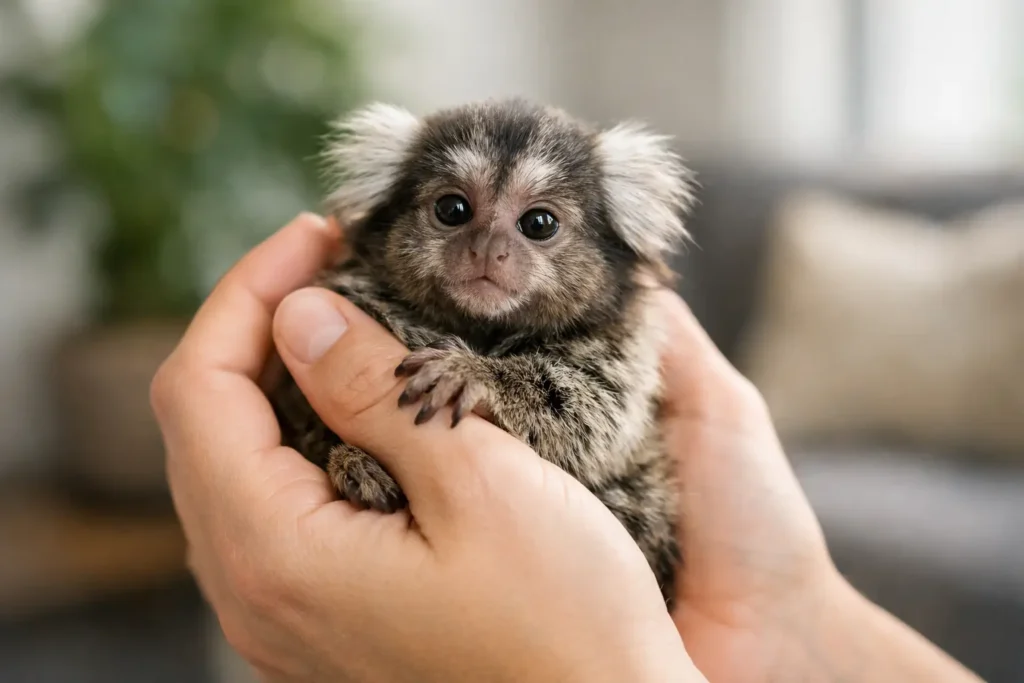
A baby marmoset may fit in your hands, but the decision to welcome one home should never be made on a small-animal timeline. Hand-raised marmoset monkeys are intensely social, highly intelligent primates whose earliest experiences with people can shape how they respond to their future family. That closeness is meaningful, but it also creates a serious obligation: a marmoset needs prepared, legally eligible caregivers for every stage of life.
For the right household, a carefully placed infant can become a remarkably affectionate companion. For an unprepared household, even the most loved baby can face stress, isolation, unsafe handling, and gaps in medical care. The responsible question is not simply, “Do I want a marmoset?” It is, “Can my home reliably meet the needs of a primate for years to come?”
What Hand-Raising Means for a Baby Marmoset
Hand-raising is not a shortcut to a toy-like pet or a guarantee that an animal will behave like a human child. It refers to a nursery-based approach in which a baby receives regular, thoughtful human interaction during its earliest development. When done responsibly, this socialization can help a marmoset become comfortable with gentle handling, routine care, feeding interactions, and the sounds and rhythms of a family home.
That early foundation matters because marmosets are not domesticated animals. They remain primates with species-specific instincts, communication, dietary needs, and emotional needs. A hand-raised baby may form a close attachment to its caregivers, but it still needs structure, respectful boundaries, enrichment, and a setting designed for a marmoset rather than adapted casually after arrival.
Responsible breeding and placement should begin well before a family sees a baby. Ask how infants are monitored, whether veterinary evaluations are part of the process, how the breeder approaches early socialization, and what support remains available after placement. A reputable placement process should feel thorough, not rushed.
The First Question Is Whether Ownership Is Legal
Before choosing a baby, confirm that private marmoset ownership is permitted where you live. Rules can differ by state, county, city, homeowners association, and rental agreement. Some areas prohibit primates outright. Others require a permit, inspection, proof of enclosure standards, veterinary documentation, or specific liability coverage.
Do not rely on a general internet answer or assume that a neighboring state’s rules apply to you. Call the appropriate state wildlife or agriculture agency and your local animal-control or zoning office. If you lease your home, get written approval from the property owner. If a permit is required, understand the application timeline before making plans for a homecoming.
A USDA-licensed breeder’s status is meaningful in the breeding and placement process, but it does not override the laws that apply to an individual owner. Legal preparation protects your household, your community, and most importantly, the marmoset from an avoidable relocation.
A Marmoset Home Needs More Than a Spare Room
A nursery setup should be clean, warm, secure, and easy to supervise. Long-term care requires more: a purpose-built enclosure that provides safe climbing opportunities, varied levels, appropriate resting spaces, and room to move naturally. Marmosets are active, agile animals. A cage chosen only because it fits a room is not necessarily a suitable living environment.
The enclosure must also protect the marmoset from common household dangers. Dogs, cats, open doors, ceiling fans, toxic plants, electrical cords, scented products, and unsupervised guests can all create real risks. Temperature stability matters, especially for a small primate that may be vulnerable to drafts and sudden environmental changes.
Enrichment is not an optional extra. Branches, ropes, safe climbing structures, feeding activities, and regularly refreshed objects give a marmoset opportunities to investigate and problem-solve. The goal is not constant entertainment. It is a daily environment that allows natural movement and engagement rather than boredom and frustration.
Daily Care Is a Family-Wide Commitment
Marmosets thrive on consistent caregiving. They need daily feeding, fresh water, enclosure sanitation, supervised interaction, and careful observation for changes in appetite, stool, activity, or behavior. Their diet should be developed with a qualified exotic-animal veterinarian and followed precisely. Feeding an appealing assortment of human foods is not responsible nutrition.
These animals can be vocal, especially when calling for their bonded people or responding to changes around them. They may scent-mark, resist changes in routine, and become distressed if left alone for long stretches. A marmoset is not a suitable companion for a household that travels frequently without qualified care arranged, works unpredictable hours with no support system, or expects the animal to remain quietly contained throughout the day.
Children require particular planning. A marmoset should never be treated as a child’s pet, passed around for photos, or left unsupervised with young family members. Adults must remain the primary caregivers and teach every person in the household how to approach, handle, and respect the animal safely.
Veterinary Planning Cannot Wait Until There Is a Problem
Finding a veterinarian experienced with nonhuman primates can take time, and emergency care may be farther away than your usual animal clinic. Establish that relationship before your marmoset comes home. Ask about routine wellness visits, after-hours protocols, diagnostic capabilities, and how the practice handles a small primate’s unique care requirements.
Build a realistic budget that includes more than the initial placement cost. Appropriate housing, enclosure improvements, specialized food, enrichment materials, permits, veterinary care, emergency treatment, and qualified boarding or in-home care all carry ongoing costs. The financial commitment is part of responsible ownership, not an unpleasant detail to solve later.
Health guarantees and veterinary examinations can provide valuable peace of mind during placement, but they are only the beginning. Your household will still be responsible for lifelong preventive care and fast action when something seems wrong. Small animals can decline quickly, so a caregiver’s attention is one of the most valuable safeguards a marmoset has.
How to Recognize a Responsible Placement Process
The best fit is not always the first available baby or the nearest seller. A responsible breeder or placement partner should ask detailed questions about your home, local laws, enclosure plans, experience, schedule, and veterinary preparation. Screening is a sign that the animal’s welfare is being taken seriously.
Before moving forward, be prepared to discuss these four areas clearly:
- Your confirmed state and local legal requirements, including any permits or inspections.
- Your enclosure plan, household safety measures, and daily enrichment routine.
- Your primate-qualified veterinary relationship and emergency-care plan.
- Your long-term budget, travel coverage, and adult caregivers who can share responsibility.
You should also receive clear information about the individual marmoset’s age, temperament, feeding routine, health history, transition needs, and transportation plan. Each baby is an individual. Some may be especially curious and outgoing; others may need a more gradual adjustment period. Matching temperament to household expectations is more responsible than making a decision based on appearance alone.
A concierge-style process can be especially valuable for first-time qualified owners because it organizes the transition from application to preparation to homecoming. Premier Primates approaches placement as a supported relationship, with an emphasis on responsible screening, preparation, and continued guidance for approved families.
The Bond Is Real, and So Is the Responsibility
People are drawn to marmosets because of their expressive faces, tiny hands, and remarkable engagement with trusted caregivers. Those qualities can create a bond unlike that of many companion animals. But affection should never be separated from welfare. A marmoset’s dependence on its family is precisely why the family must be ready for the work.
Think through life changes before you commit: a move, a new baby, career travel, illness, divorce, retirement, or a shift in finances. The plan should not be to “figure it out” if circumstances change. The plan should already include who can provide qualified care and how the marmoset’s stability will be protected.
The right home for a hand-raised marmoset is calm, prepared, compliant, financially capable, and deeply committed to daily care. If that describes your household, take the next step slowly: verify your laws, build the proper environment, establish veterinary support, and choose a placement partner who treats your future companion with the same care you intend to provide.