A baby primate may be raised with love, carefully socialized, and ready for a home, but none of that changes the first responsibility of ownership: confirming that your home is legal before you commit. Permits for pet monkeys are not a single national form or a quick checkbox. They can involve state wildlife agencies, county offices, city ordinances, zoning rules, veterinary documentation, and species-specific standards.
For prospective Capuchin, Marmoset, or Squirrel monkey owners, the right question is not simply, “Can I get a permit?” Ask, “What will my state and local agencies require for me to keep this particular species safely for its entire life?” That mindset protects your family, your community, and most of all, the primate depending on you.
Why Monkey Permits Vary So Much
The United States does not have one universal pet-monkey permit. Private primate ownership is governed largely at the state and local level, which means a legal placement in one area may be prohibited a few miles away across a county or city line.
Some states allow certain nonhuman primates with a wildlife possession permit. Others permit ownership only under narrow conditions, such as prior experience, a specific enclosure, liability insurance, veterinary documentation, or registration. Some states prohibit private possession of primates altogether. Even where state law permits ownership, a city, town, homeowners association, or landlord may impose stricter rules.
Species matters, too. Agencies may classify small primates differently from larger primates, or place all primates in a restricted wildlife category. Never assume that approval for one animal applies to another species, or that a permit held by a previous owner transfers automatically to you.
Rules can also change. A social-media post, an old forum thread, or a neighbor’s experience is not reliable legal guidance. The agency responsible for enforcement is the only source that can confirm what applies to your exact address and intended species.
Start Permit Research Before Choosing a Monkey
The most responsible time to research permits for pet monkeys is before placing a deposit, building an enclosure, or making emotional promises to your family. Legal preparation should be part of choosing the right companion, not paperwork left until the end.
Begin with your state wildlife, fish and game, agriculture, or natural-resources department. Explain that you are considering private ownership of a captive-bred primate and ask which rules apply to the species you are considering. Request the current application, fee schedule, renewal requirements, inspection rules, and enclosure standards in writing whenever possible.
Next, check the rules closer to home. Contact your county animal control office, city clerk, zoning department, and, if applicable, your homeowners association or property manager. Ask whether exotic-animal restrictions, noise ordinances, business-use rules, or setback requirements affect a residential primate enclosure. A state permit does not override a local ban.
It is wise to keep a written record of every conversation, including the date, agency, staff member, and guidance provided. If a regulation is unclear, ask for the specific statute, code section, or written policy. This creates a useful file for your application and helps prevent costly misunderstandings later.
Questions to Ask the Agency
Clear questions lead to clearer answers. Ask whether private possession is allowed for your species, whether an application must be approved before the animal arrives, and whether your permit is tied to a specific animal or property address. Find out whether the agency requires photographs, diagrams, inspections, veterinary records, proof of experience, emergency plans, or annual renewals.
Also ask what happens if you move, travel with the animal, change veterinarians, or need to transfer the primate to another approved home. A lifelong companion deserves a plan that accounts for life changes, not only homecoming day.
Build the Home They Expect to See
Permit approval often depends on more than a completed form. Agencies want evidence that the animal will be secure, humanely housed, and manageable throughout its life. A primate is intelligent, agile, and deeply social. A spare cage in a guest room rarely meets the standard for responsible long-term care.
Your enclosure should be designed for the individual species, age, size, and temperament of the monkey. In general, officials may evaluate construction materials, secure doors and locks, climbing opportunities, indoor shelter, weather protection, sanitation, drainage, food storage, and separation areas for veterinary care or emergencies. Depending on your location, they may also require a perimeter barrier or specific distance from neighboring homes.
Enrichment is not an optional extra. Primates need a daily environment that supports movement, problem-solving, safe exploration, and interaction. An agency may focus on basic housing measurements, but responsible ownership reaches further. The goal is not to meet the minimum on paper. The goal is to create a stable, engaging home where your companion can thrive.
A professional enclosure plan is especially helpful when an inspection is required. Take dated photographs as construction progresses, save receipts for materials, and maintain a simple diagram showing dimensions, access points, resting areas, and safety features. These details make your preparation easier to explain and demonstrate that your plan was built around the animal’s welfare.
Prepare a Complete Permit File
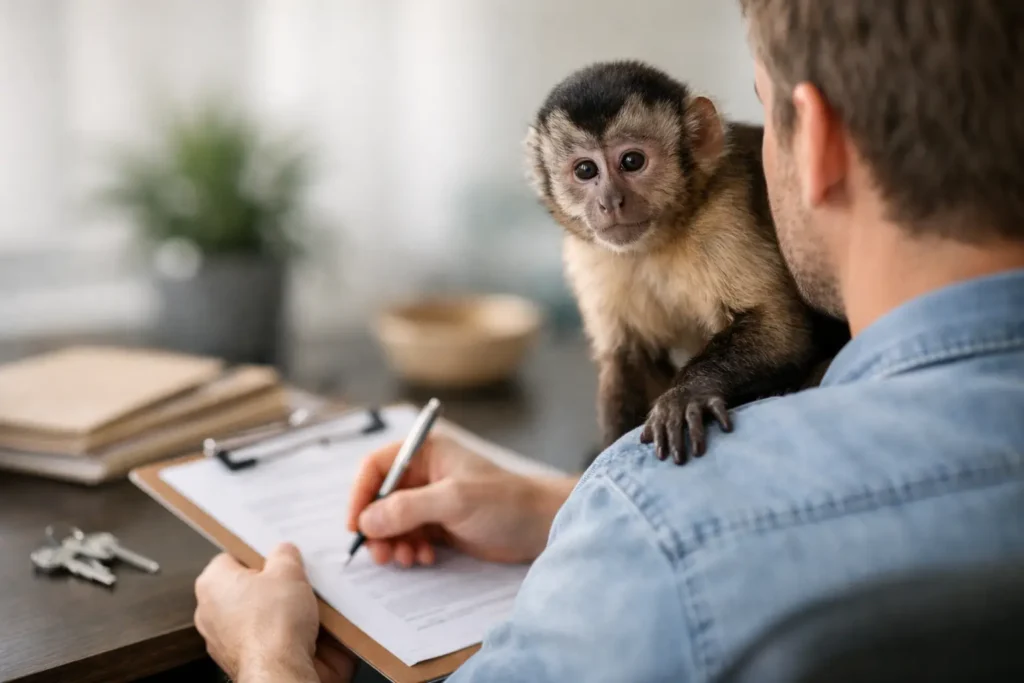
A well-organized file can make the application process less stressful. Requirements differ by jurisdiction, but applicants are commonly asked to provide several forms of documentation:
- A completed possession or wildlife permit application, with applicable fees
- Proof of lawful acquisition from a qualified, captive-breeding source
- Photos, measurements, or a diagram of the proposed enclosure
- A written care, feeding, and enrichment plan
- Contact information for an experienced exotic-animal veterinarian
- An emergency, escape-response, and disaster-preparedness plan
- Evidence of experience, training, inspection approval, insurance, or local authorization when required
Do not submit documents you have not reviewed carefully. A small inconsistency, such as an address mismatch or vague enclosure description, can delay approval. If an official requests additional information, respond promptly and keep copies of everything you send.
Your records should remain organized after approval. Store your permit, renewal dates, veterinary records, transport paperwork, enclosure photos, and agency correspondence in one secure place. Should an inspector visit, or should an emergency require another person to step in, that file becomes part of your animal’s safety plan.
Federal Rules and Interstate Transport
Many future owners hear the phrase “USDA licensed” and assume it is the permit needed to keep a monkey as a pet. These are different issues. USDA oversight may apply to breeders, dealers, exhibitors, and certain regulated activities under federal animal-welfare rules. It does not automatically grant a private owner permission to possess a primate in a state or municipality that restricts ownership.
Transport can introduce another layer of requirements. Depending on the route, species, and destination, movement may involve health certificates, veterinary examinations, carrier standards, timing rules, or state entry requirements. A legal origin does not guarantee legal arrival. The destination rules must be confirmed before travel is scheduled.
This is one reason a full-service placement process matters. At Premier Primates, permit-research guidance and delivery coordination are part of helping approved families prepare thoughtfully. Guidance is valuable, but the future owner remains responsible for securing every required approval and maintaining it over time.
Approval Is the Beginning of the Commitment
A permit is permission to take on a serious obligation, not proof that the work is finished. Many permits require renewal, and some agencies can inspect the property or request updated information. If your enclosure changes, you relocate, or your animal’s circumstances change, notify the appropriate agency before assuming your existing paperwork still applies.
Plan for the expenses that live beyond the application fee: specialized veterinary care, a high-quality diet, enclosure maintenance, enrichment, secure transport, and backup care. Before bringing a primate home, identify a veterinarian comfortable with primate medicine and a trusted emergency contact who understands the animal and your written care instructions.
There is also a human side to compliance. Be considerate of neighbors, protect privacy around the enclosure, and never treat a primate as a novelty. Thoughtful ownership helps preserve the possibility of responsible private placement for families who are truly prepared.
If Your Area Does Not Allow Private Ownership
A denial can feel disappointing, particularly after you have spent time learning about a species and imagining a future companion. But bringing a primate into a prohibited area puts everyone in a difficult position. Confiscation, fines, forced relocation, and separation from a bonded family are painful outcomes that responsible planning can prevent.
Do not try to work around a restriction by calling the animal a service animal, registering it under another person’s name, or relying on informal assurances. If your location does not permit private ownership, respect that boundary. You may decide to wait, consider a move only after thorough research, or support primate welfare in another meaningful way.
The best homecoming begins long before a nursery visit or delivery date. Give permits, enclosure planning, veterinary relationships, and emergency preparation the same care you would give choosing your future companion. When the legal foundation is in place, you can welcome your primate into a home prepared to protect them for the years ahead.